A mobile vacuum lift can feel steady on a smooth warehouse floor, then jolt when a caster meets a joint, ramp edge, or loose cable. That movement can shift the load and challenge the operator’s control. Small details matter. Before moving, check the floor, load, route, and equipment manual; a safe method depends on the lift’s design and the surface beneath it. How to move a mobile vacuum lift across uneven floors? The answer starts with assessing the route, not pushing harder.
The risk is part of a wider material-handling problem. The U.S. Bureau of Labor Statistics reported 2.6 million nonfatal workplace injury and illness cases in private industry for 2023. That figure is not specific to vacuum lifts, but it shows why practical controls deserve attention. OSHA materials-handling guidance likewise emphasizes evaluating tasks and using suitable equipment. On a real route, that means looking for cracked concrete, thresholds, wet patches, and tight turns before travel begins. A spotter may help where visibility is limited, but the equipment maker’s instructions remain essential. There is no universal speed or slope that suits every lift. I would not treat a brief test on one bump as proof that the whole route is safe. This guide outlines checks for moving a mobile vacuum lift across uneven floors, while recognizing that site conditions—and lift designs—differ.
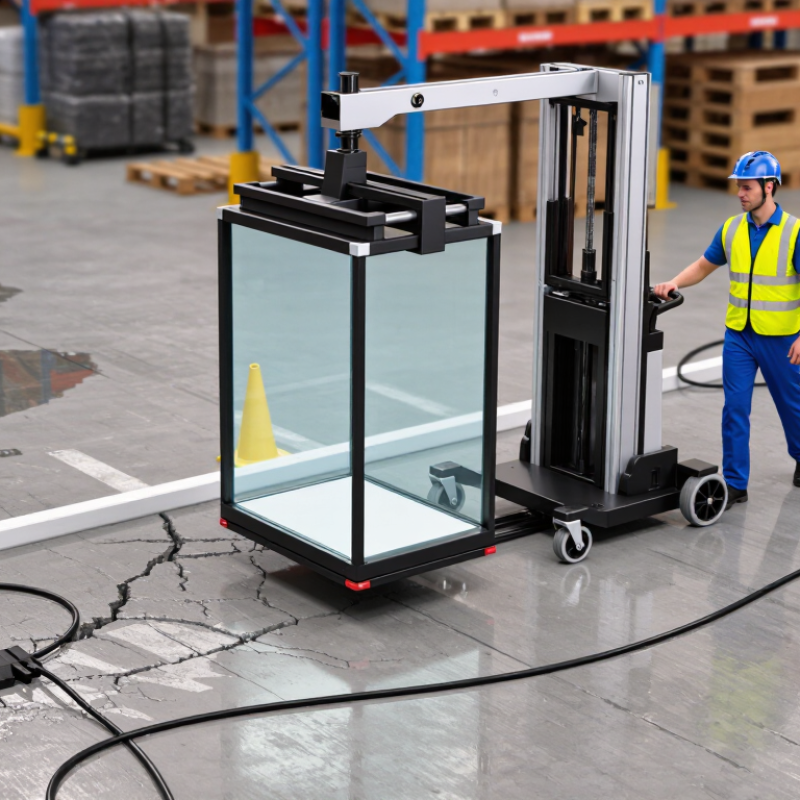
Before moving a mobile vacuum lift, walk the entire route without the machine. Check door thresholds, floor joints, drain covers, and cracks. A small gap can catch a caster or jolt a suspended load. Measure openings and step heights with a tape measure, rather than judging them by eye. Mark awkward spots with removable tape.
Gradients need attention too. Use a level or inclinometer to identify ramps, cross-slopes, and sudden changes in pitch. A route that feels flat while walking may still tilt the lift enough to affect stability. Check the floor near corners and transitions, where slopes can change quickly. Note the measurements and compare them with the lift manufacturer’s operating instructions. Do not assume that a powered drive makes a steep section safe.
Inspect the wheels and confirm the load is secured before travel. Keep the route clear, move slowly, and avoid turning on uneven ground when possible. If a gap, step, or gradient exceeds the equipment’s stated limits, choose another route or arrange suitable assistance. Pause there. One practical detail is easy to miss: floor conditions may change after cleaning, repairs, or nearby work. Recheck the path on the day of the move, even if it was surveyed earlier.
| Survey Item | Example Site Measurement | What to Check | Practical Action Before Moving |
|---|---|---|---|
| Floor gaps and joints | 12 mm-wide expansion joint; approximately 8 mm deep | Measure the widest opening and note its direction relative to the travel route. Check for loose covers or damaged edges. | Confirm the wheel size and gap-crossing limits in the lift’s operating instructions. Use an approved, secured bridge plate if required; do not roll across an unprotected gap if suitability is uncertain. |
| Raised thresholds | 18 mm vertical change at a doorway | Measure the vertical height and inspect whether the edge is sharp, rounded, or beveled. | Check the equipment instructions for allowable transitions. Use a suitable secured threshold ramp when permitted, and move slowly with a spotter if visibility or stability is limited. |
| Single step | 100 mm rise with a 280 mm tread | Record the step height, tread depth, edge condition, and whether a ramp or lift is available. | Do not assume a mobile vacuum lift can climb or descend a step. Use an approved ramp or appropriate lifting and transport method; keep the load stable and follow the manufacturer’s procedure. |
| Gradient | 6% slope, equivalent to about 60 mm rise per 1 m of horizontal travel | Measure the steepest section, including short ramps, and identify the direction of travel and any cross-slope. | Compare the measured gradient with the lift’s rated operating limits. If the limit is unknown or exceeded, do not proceed; select a flatter route or another approved method. |
| Cross-slope | 2% side-to-side slope across the route | Check whether the floor tilts sideways, especially near ramps, drains, or uneven paving. | Assess the risk of the load or equipment drifting or becoming unstable. Choose a more level route if needed and use a spotter where appropriate. |
| Surface condition | Uneven concrete with loose grit and a damp patch | Look for debris, oil, water, loose flooring, potholes, and changes in surface grip. | Clear debris and address slippery or unstable areas before moving. Do not travel over a surface that could reduce traction or compromise stability. |
| Route width and turning space | 1.1 m clear width; 1.5 m turning area | Measure the narrowest point and turning area, including door hardware and stored materials. | Check the equipment’s overall dimensions and turning requirements. Clear the route and plan turns before moving the lift. |
| Final route walk-through | Route checked from the starting position to the destination | Confirm measurements, surface conditions, access restrictions, and visibility along the whole route. | Agree on a travel plan, keep the load within the equipment’s rated capacity, and stop if conditions differ from the survey or the lift becomes difficult to control. |
Note: Example measurements are for route-survey planning only, not universal operating limits. Always check the specific lift’s instructions, rated capacity, and permitted floor and gradient conditions before moving.
Walk the full route first. Measure thresholds, floor gaps, step heights, and openings with a tape measure. Mark difficult spots.
Use a level or inclinometer to check ramps, cross-slopes, and changes in pitch. Compare measurements with the lift’s operating instructions. A powered drive does not make every slope safe.
Cleaning, repairs, or nearby work may change the route. Recheck it that day, even if it was surveyed earlier. Easy to miss.
It is a design and verification requirement, not extra lifting capacity. Never use it to justify exceeding the marked working load.
Check the rated capacity, approved configuration, load direction, and required vacuum level. Make sure pads are clean and the contact surface is suitable.
Pause on stable ground, with the load supported as instructed. Check the indicators, gauge, and alarm before moving again. Watch the reading for several seconds.
Stop and follow the equipment procedure. Do not continue while a warning remains or the display is uncertain. Ask a trained operator to assess repeated alarms.
Look for loose hoses, shifted pads, or trapped debris. Never reach beneath a suspended load. A quick glance can miss a changing gauge.
Choose another route or arrange suitable assistance if a gap, step, or slope exceeds the equipment’s stated limits. Stop if wheels lift, the frame rocks, or vacuum readings change.
How to move a mobile vacuum lift across uneven floors? Start by surveying the route carefully, including floor gaps, step heights, surface changes, and gradients. This assessment helps identify potential tipping points and obstacles before the lift is moved. Confirm that the vacuum lifter’s safety factor is 2:1 and that its operating conditions align with EN 13155 requirements. The wheels should also be suitable for the surface, with a size and load rating that remain within the manufacturer’s stated limits.
When crossing uneven sections, move slowly and keep the load as low as practical to improve stability. Secure the load properly before beginning and avoid sudden turns, stops, or changes in direction. After passing over every significant gap, step, or raised area, recheck the vacuum indicators and alarms to confirm that suction remains stable. A careful route assessment, correct wheel selection, controlled movement, and regular vacuum checks can make handling safer and more predictable on uneven floors.

 Bendo Lift